
Share Article
Transitioning to Value-Based Care (VBC) creates an opportunity for medical practices to improve clinical outcomes while succeeding under performance-based reimbursement models. But achieving strong results across core quality measures—such as diabetes management, blood pressure control, and depression screening—requires more than simply delivering good clinical care.
Many medical groups face a fundamental disconnect: they deliver high-quality patient care, but their data and EHR workflows fail to fully reflect it.
Between 2023 and 2026, Netrin Health worked directly with partner practices to strengthen clinical workflows, improve documentation, address data gaps, and create greater visibility into quality performance.
The results were significant. Across participating practices, measurable improvements were seen in HbA1c Poor Control, Hypertension Control, and Depression Screening & Follow-Up.
The Baseline: Primary Operational Bottlenecks
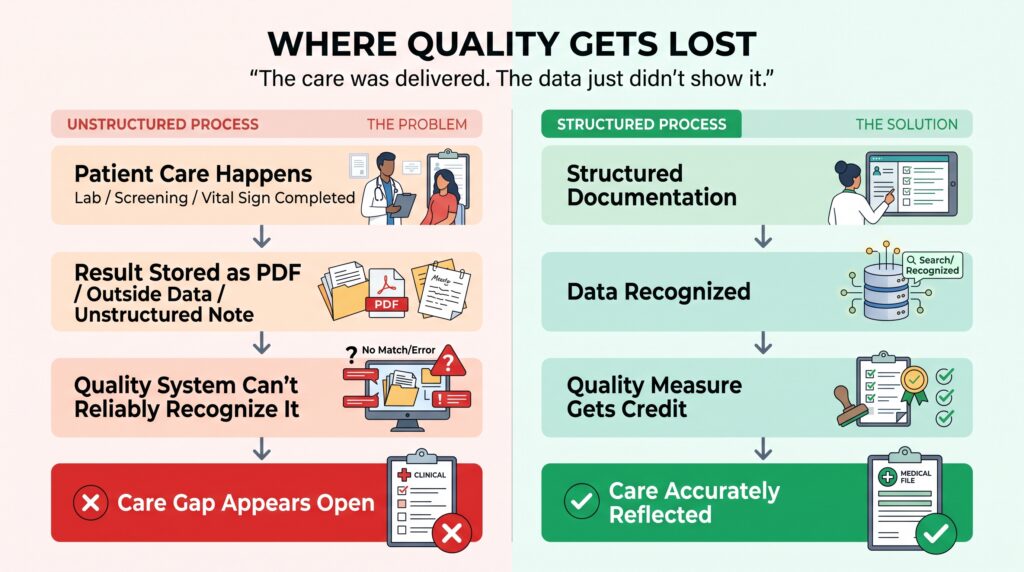
Before re-engineering clinical and data workflows, practices commonly encountered several operational barriers that affected their reported quality performance:
- Unstructured Data & “Invisible” Results: Lab reports and specialist results were often scanned into the EHR as PDF attachments rather than recorded in structured, discrete data fields. As a result, automated quality reporting tools could fail to recognize completed care.
- Reactive, End-of-Year Outreach: Care gaps were frequently addressed late in the performance year, creating unnecessary pressure on practice staff and limiting the time available to reach patients and complete needed services.
- EHR Silos & Missing Standard Codes: Outside laboratory results did not always contain standardized LOINC terminology mapping, while manual data extraction processes could result in completed clinical care not being properly reflected in quality reporting.
The Core Interventions: A 3-Step Execution Framework
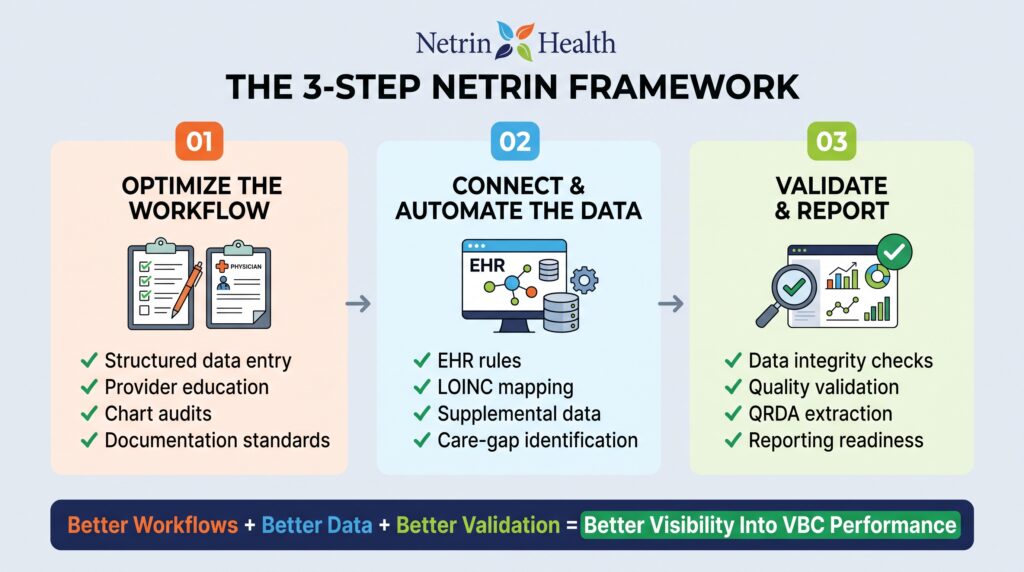
To address these technical and operational bottlenecks, Netrin Health worked with partner practices on a three-part quality improvement framework.
Step 1: Workflow Education & Documentation Optimization
- Structured Data Entry Standards: Clinical teams were educated on entering vital signs, A1c values, screening assessments, and other quality-related information into structured EHR fields rather than relying solely on scanned documents.
- Routine Provider Chart Audits: Quality chart audits identified documentation patterns that could result in missed quality credits. Findings were shared directly with clinical teams to improve documentation workflows without unnecessarily increasing administrative burden.
Step 2: EHR Automation & Data Engineering
- Point-of-Care Rules Engine: Clinical rules and alerts were configured within EHR workflows to help identify open care gaps during patient rooming, pre-visit planning, and clinical encounters.
- Terminology & LOINC Mapping: Standardized mapping processes helped align external laboratory data with appropriate LOINC codes so outside results could be properly recognized.
- Supplemental Data Format (SDF) Integration: Where native integrations were limited, supplemental data files and external data partnerships helped close gaps in clinical data capture.
Step 3: Data Validation & Regulatory Reporting
- Continuous Data Validation: Routine data integrity reviews helped identify missing or inconsistent information before final quality reporting deadlines.
- Streamlined QRDA Extractions: Quality Reporting Document Architecture (QRDA) extraction processes were standardized to support cleaner, more reliable reporting to applicable registries and payers.
Before & After: Real Results Across Partner Practices
Over the 2023–2026 period, partner practices achieved substantial improvements across several important VBC quality measures.
Exceptional Progress in Diabetes (HbA1c) Control
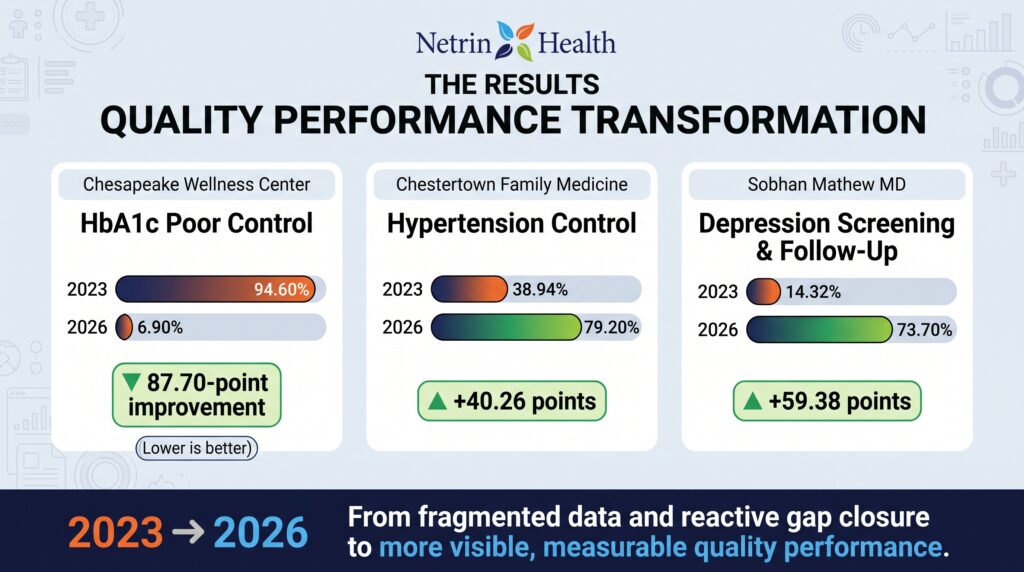
For HbA1c Poor Control, lower percentages represent better performance.
- Chesapeake Wellness Center: Improved from 94.60% in 2023 to 6.90% in 2026, an 87.70 percentage-point improvement.
- Sobhan Mathew MD: Improved from 61.54% to 5.40%, a 56.14 percentage-point improvement.
- Plotsky Medical Associates, PC: Improved from 65.00% to 19.00%, a 46.00 percentage-point improvement.
Outstanding Gains in Hypertension Control
- Chestertown Family Medicine: Increased hypertension control from 38.94% in 2023 to 79.20% in 2026, a 40.26 percentage-point improvement.
- Gurmeet Sawhney MD: Increased from 67.20% to 98.19%, a 30.99 percentage-point improvement.
- Potomac Advanced Medical Care: Increased from 51.85% to 74.58%, a 22.73 percentage-point improvement.
Strong Advancements in Depression Screening & Follow-Up
- Sobhan Mathew MD: Increased from 14.32% in 2023 to 73.70% in 2026, a 59.38 percentage-point improvement.
- Medpeds LLC: Increased from 34.08% to 74.38%, a 40.30 percentage-point improvement.
- Family Medicine Shady Grove: Increased from 72.64% to 98.24%, a 25.60 percentage-point improvement.
Performance Summary
| Quality Measure | Practice Name | 2023 Baseline | 2026 Score | Total Improvement |
| HbA1c Poor Control (Lower is better) | Chesapeake Wellness Center | 94.60% | 6.90% | 87.70 pts |
| HbA1c Poor Control (Lower is better) | Sobhan Mathew MD | 61.54% | 5.40% | 56.14 pts |
| HbA1c Poor Control (Lower is better) | Plotsky Medical Associates, PC | 65.00% | 19.00% | 46.00 pts |
| Hypertension Control | Chestertown Family Medicine | 38.94% | 79.20% | 40.26 pts |
| Hypertension Control | Gurmeet Sawhney MD | 67.20% | 98.19% | 30.99 pts |
| Hypertension Control | Potomac Advanced Medical Care | 51.85% | 74.58% | 22.73 pts |
| Depression Screening & Follow-Up | Sobhan Mathew MD | 14.32% | 73.70% | 59.38 pts |
| Depression Screening & Follow-Up | Medpeds LLC | 34.08% | 74.38% | 40.30 pts |
| Depression Screening & Follow-Up | Family Medicine Shady Grove | 72.64% | 98.24% | 25.60 pts |
What the Results Tell Us
1. Clinical Care and Data Capture Have to Work Together
Delivering the right care is only part of succeeding in Value-Based Care. The underlying documentation and data infrastructure must also accurately capture that work.
A completed laboratory test stored only as a scanned attachment may not be recognized by an automated quality engine. Structured documentation helps ensure that completed clinical work is visible in quality reporting.
2. Quality Improvement Should Happen Throughout the Year
Waiting until the end of the performance year to identify care gaps creates unnecessary operational pressure.
Routine data review, pre-visit planning, point-of-care alerts, and ongoing patient outreach allow practices to address gaps as part of everyday clinical operations.
3. Data Integrity Can Directly Affect Reported Performance
Quality performance is only as reliable as the underlying data.
Standardized terminology, appropriate LOINC mapping, supplemental data integration, routine validation, and reliable regulatory extraction processes help ensure that quality reporting accurately reflects the care being delivered.
The Takeaway: Workflow + Data Integrity = VBC Success
The experience across these partner practices demonstrates an important principle:
High-performing Value-Based Care requires clinical workflows, technology, and data infrastructure to operate as one system.
When practice teams understand how to document correctly, care gaps are visible at the point of care, outside clinical information is properly incorporated, and data is continuously validated, practices are better positioned to improve quality performance.
The improvements achieved between 2023 and 2026 demonstrate what can happen when clinical education, EHR workflow optimization, data engineering, and ongoing quality management are brought together.
For practices and ACOs, the objective is not simply to chase quality measures at the end of the year.
It is to build an operating model in which closing gaps becomes part of everyday care.
Frequently Asked Questions (FAQ)
How can practices improve HbA1c poor control performance in VBC programs?
Practices can strengthen performance by improving structured EHR documentation, identifying patients who are overdue for testing, incorporating external laboratory results, standardizing LOINC mapping, and using pre-visit planning and point-of-care workflows to address gaps throughout the year.
Why can scanned PDF data result in missed quality measure credit?
Many automated quality reporting processes rely on structured EHR data. When clinical information exists only within a scanned document, the underlying result may not be available as discrete data for automated extraction and reporting.
What is the role of LOINC mapping in quality reporting?
LOINC provides standardized identifiers for laboratory tests and clinical observations. Mapping local laboratory codes to standardized LOINC terminology helps outside clinical results become recognizable within data and quality reporting workflows.
What is the biggest lesson from these results?
Quality improvement is not just a reporting exercise. Sustainable improvement occurs when clinical workflows, documentation, patient engagement, EHR configuration, and data integrity are managed together throughout the performance year.