
Share Article
Accountable Care Organizations remain one of the most important levers for improving quality and lowering costs in the U.S. healthcare system. While performance is still achievable, Healthcare Finance News recently reported that out of 476 ACOs, 75 percent earned performance payments totaling $4.1 billion, representing 80 percent of all assigned beneficiaries, but reaching that level of success is getting harder. Expectations from CMS and commercial payers are growing, patient populations are becoming more clinically complex, and the volume of data ACOs must manage has grown exponentially.
At the same time, many organizations also lack the tools, infrastructure, and operational capacity to turn that data into meaningful, day-to-day action. Most especially, smaller and mid-size ACOs often find themselves up against larger network growth, deeper resources, more mature workflows, and dedicated analytics teams. The result is a widening performance gap, one that makes shared savings and high-quality results progressively difficult without smarter people, processes, and technology working in tandem.
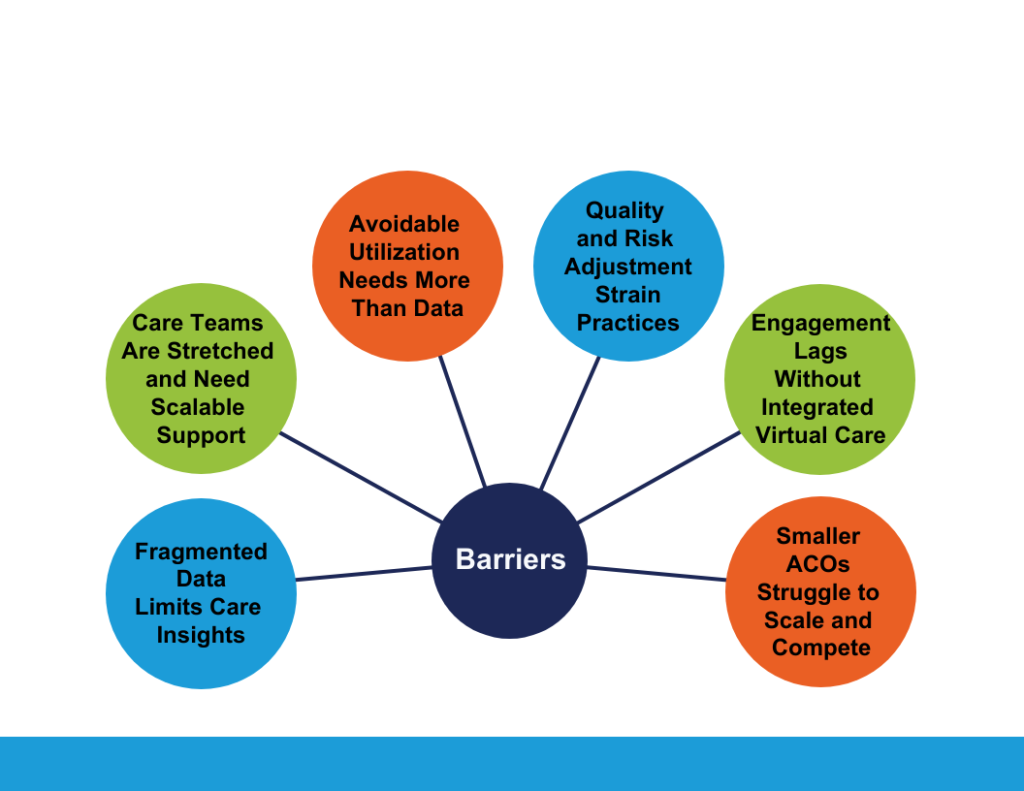
The Biggest Barriers Holding Back ACO Performance
When data doesn’t guide action, performance stalls.
ACOs now sit on more data than ever, including claims, clinical records, and population health analytics. The problem is that this information rarely comes together in a way that supports day-to-day decision making. Many teams still rely on manual reports or dashboards that describe what happened instead of what to do next. This leads to missed opportunities in high-risk patient management and gap closure. For a deeper look at this issue, see our blog titled The Data Backbone of a Successful ACO: Why Population Health Analytics Is Your Competitive Advantage.
What works:
A unified data layer combined with predictive analytics and point-of-care recommendations turns raw information into clear action steps. When care teams know who to engage, why, and when, performance becomes more consistent.
When care teams are stretched thin, execution breaks down.
Primary care practices face unprecedented staffing pressure. Clinicians, care coordinators, and administrative staff are juggling rising patient complexity and demands with limited time and resources. Even high-performing ACOs struggle to execute outreach, chronic disease management, and care coordination at the scale needed for shared savings.
What works:
Bringing in a third-party care management partner helps relieve pressure on practice staff. They can handle outreach, follow up, and care coordination at scale, freeing your team to focus on higher-value clinical work. This shared-workforce model boosts capacity without adding to burnout.
When utilization is managed reactively, costs stay high.
Most ACOs know which patients frequently visit the emergency department or drive high costs. The real challenge is reducing those events in a consistent and proactive way. Without real-time notifications, structured transitional care workflows, and patient-level root-cause analysis, teams often remain reactive.
What works:
Utilization data becomes powerful when paired with real-time alerts, dedicated care transition teams, and targeted programs such as home-based care, RPM, or social support services. When ACOs can intervene before or immediately after an acute event, they can meaningfully lower avoidable emergency visits and readmissions.
When quality and risk adjustment overwhelm practices, performance suffers.
CMS continues to raise expectations for both quality scoring and risk adjustment. Provider organizations face significant documentation, coding, and reporting workloads. Many practices do not have enough staff or the right systems to close HEDIS gaps, capture chronic conditions accurately, or complete timely annual wellness visits.
What works:
Centralized reporting, automated gap lists, in-workflow coding support, and dedicated clinical teams for AWVs and chronic care management help reduce the burden. Streamlining these processes improves quality scores and enhances overall ACO performance.
When patient engagement ends at the office visit, gaps persist.
Many ACOs still rely heavily on phone calls, portal messages, or mailed reminders. These methods only reach a portion of the population. Patients with chronic illnesses, those who are hard to contact, and individuals with social barriers often fall through the gaps, which limits quality performance and increases avoidable utilization.
What works:
Integrated virtual care programs such as RPM, telehealth, care navigation, and social support services close these gaps by meeting patients where they are. When engagement extends into the home and between office visits, adherence improves and complications decrease.
When scale is limited, competition becomes harder.
Large ACOs tend to benefit from advanced analytics, dedicated care teams, and stronger financial resources. Smaller and mid-size organizations often operate with limited budgets and fragmented infrastructure. This makes it difficult to compete on benchmarking, quality performance, and care coordination.
What works:
Scale can come from smarter enablement rather than organization size. Shared services, virtual care teams, centralized analytics, and turnkey operational support allow smaller ACOs to perform like much larger organizations without major overhead. With the right tools and partners, size becomes far less of a limitation.
A Proven Path Forward: The Netrin Health ACO Performance Model
Netrin Health approach brings together the three elements that drive sustainable ACO success: people, process, and tools. Our model is built around integrated care teams, evidence-based playbooks, advanced analytics, and virtual care services that work together rather than in silos. Instead of offering technology alone or staffing alone, Netrin delivers a coordinated performance engine that helps ACOs close gaps, manage high-risk patients, improve quality, and operate more efficiently.
Our capabilities are designed to scale with organizations of any size. This includes centralized care management, seamless virtual care integration that supports chronic disease programs and RPM, point-of-care insights that guide clinicians during visits, and workflows that create consistency across practices. The result is a comprehensive performance model that strengthens ACO operations and produces measurable improvements in cost and quality.
Real-World Results: How Integrated Care Models Improve Outcomes
ACOs that combine strong care teams, structured workflows, and data-driven tools consistently see improvements across their population. Integrated care models help reduce avoidable hospitalizations by identifying rising-risk patients earlier and coordinating timely interventions. Practices also close more quality gaps because they receive clearer workflows, real-time insight into patient needs, and centralized support that keeps tasks moving forward.
These models also increase patient engagement with more touchpoints beyond the office visit. With virtual care, proactive outreach, and home-based monitoring, it becomes easy for patients to remain engaged and compliant with treatment plans. When all these functions occur together, ACOs have an optimal outcome related to cost, quality, and patient satisfaction.
How ACOs Can Partner With Netrin for Better Performance
Netrin works with ACOs as a true strategic enablement partner, not just a vendor. Our goal is to strengthen the capabilities organizations already have and provide the people, processes, and tools that help close performance gaps. Whether an ACO needs support with care management, virtual care, analytics, or scalable workflows, we collaborate in a way that aligns with each organization’s strategy, structure, and population needs.
If your ACO is looking to improve consistency, lighten operational burden, or advance its value-based care model, we welcome the opportunity to talk. A short conversation can help you understand where Netrin fits and whether our approach can support your goals for the coming performance year.
Want to put the ACO playbook into action? Then we should talk. Contact us to schedule a call.